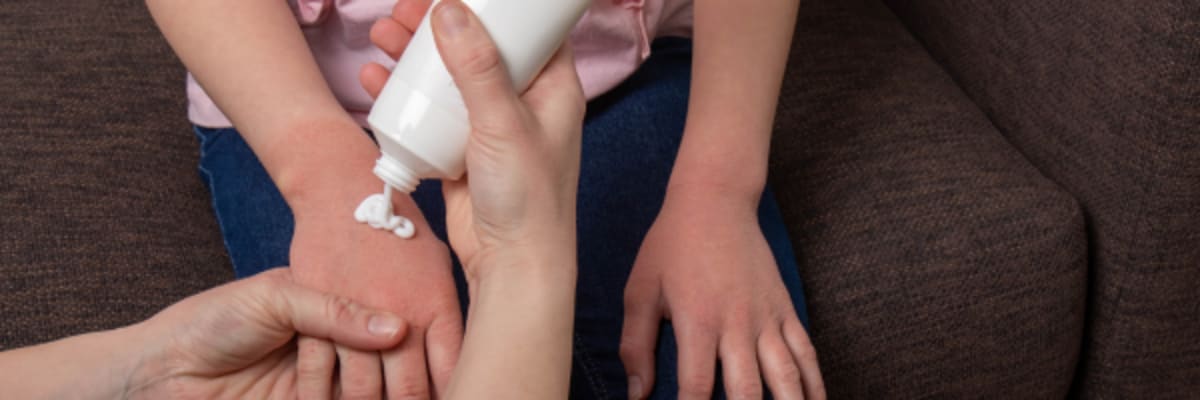
Key Takeaways:
- Atopic dermatitis (eczema) typically begins in flexural folds with intense itching and barrier dysfunction, whereas plaque psoriasis accelerates epidermal turnover from 28 days to 3–7 days.
- Topical corticosteroids are grouped by potency—from mild over-the-counter hydrocortisone to high-potency prescription betamethasone or mometasone—and matched to skin thickness and flare severity.
- Short, structured flare courses paired with daily ceramide-rich emollients rapidly calm inflammation while minimizing skin-thinning or rebound risks.
Distinguishing Eczema from Plaque Psoriasis
Living with chronic inflammatory skin disease affects sleep, comfort, and daily confidence. Although atopic dermatitis (eczema) and plaque psoriasis can look similar at a glance, identifying which condition is driving your flare is essential for choosing the right regimen.
| Clinical Feature | Atopic Dermatitis (Eczema) | Plaque Psoriasis |
|---|---|---|
| Primary Mechanism | Skin-barrier filaggrin deficiency plus Th2-mediated allergic inflammation | Immune-driven keratinocyte hyperproliferation (cells renew every 3–7 days vs. 28 days) |
| Classic Locations | Inner elbows, backs of knees, hands, neck, eyelids, and cheeks | Outer elbows, knees, scalp, lower back, and nails |
| Appearance Across Skin Tones | Dry, poorly defined red patches on lighter skin; ash-violet or dark brown patches on deeper skin tones | Well-demarcated plaques with silvery-white or ash-gray adherent scale |
| Typical Onset | Often starts in infancy or childhood; associated with asthma or seasonal allergies | Most commonly presents in adulthood (peaks at ages 20–30 and 50–60) |
How Topical Corticosteroids Calm Flare-Ups
While daily fragrance-free moisturizers rebuild the outer lipid barrier, emollients alone rarely halt an active immune flare. Topical corticosteroids bind intracellular glucocorticoid receptors to downregulate inflammatory cytokines, constrict dilated surface capillaries, and break the itch-scratch cycle before skin fissures become secondarily infected.
Formulation matters just as much as active ingredient: ointments lock in moisture and enhance penetration on thick, scaly plaques, whereas breathable creams, lotions, and foams suit weeping patches, skin folds, or hair-bearing scalp areas.
Matching Steroid Potency to Body Area
Clinicians classify topical steroids by potency so delicate skin is never over-treated and thick plaques are never under-treated:
- Mild potency (e.g., hydrocortisone 0.5%–1%): Appropriate for thin, sensitive zones such as the face, neck, or intertriginous creases during brief courses.
- Moderate potency (e.g., clobetasone or triamcinolone 0.025%–0.1%): Frequently used for trunk and limb eczema flares.
- Potent to ultra-potent (e.g., betamethasone valerate 0.1%, mometasone 0.1%, clobetasol 0.05%): Reserved for thick plaques on elbows, knees, palms, soles, or scalp under clinician supervision.
- Combination antimicrobial formulas: When heavy scratching introduces bacterial overgrowth (weeping, honey-colored crusting), clinicians may pair a short course of topical or oral antibacterial therapy with anti-inflammatory care.
Safe Application & Steroid-Sparing Maintenance
Used as directed—typically a thin fingertip-unit layer once or twice daily for 7 to 14 days during an acute flare—topical corticosteroids have an excellent safety record. Prolonged, unsupervised continuous use of high-potency steroids on thin skin can cause dermal atrophy (thinning), striae, telangiectasias, or perioral dermatitis.
Between flares, dermatologists rely on steroid-sparing strategies: generous daily ceramide ointments, calcineurin inhibitors (tacrolimus or pimecrolimus) for facial/eyelid maintenance, vitamin D analogs (calcipotriene) for psoriasis plaques, lukewarm showers, and trigger tracking.
When to Seek Dermatology Evaluation
Schedule a clinical consultation if plaques fail to improve after two weeks of directed therapy, cover a wide body surface area, involve your eyes or genitals, show signs of bacterial infection (spreading warmth, pus, fever), or accompany joint stiffness in the fingers, toes, or lower back (a potential sign of psoriatic arthritis). Explore personalized barrier and prescription dermatology options through Amble Skincare.
Leave a Reply